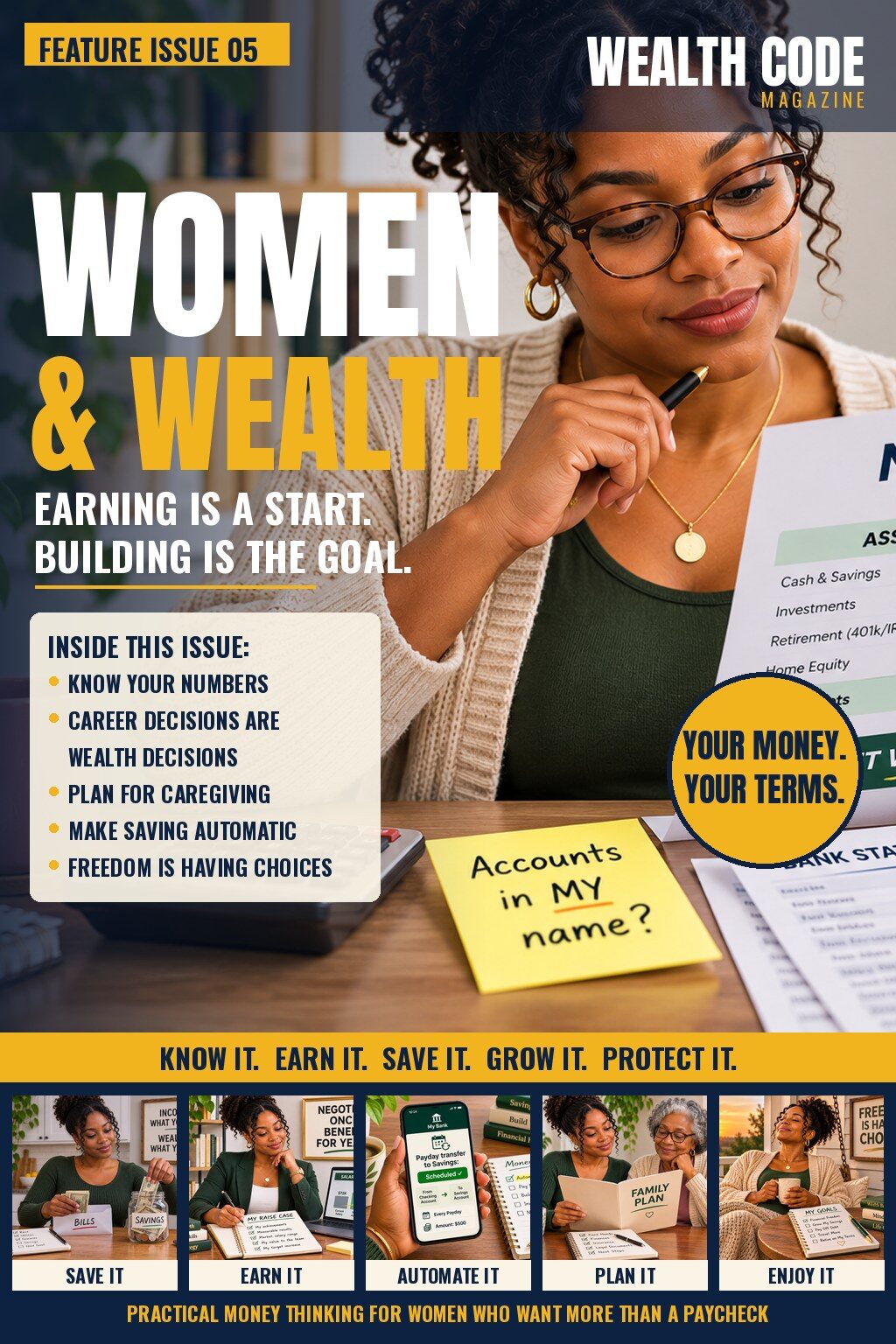
The Wealth Code Magazine · Feature Issue 05
Women and Wealth: Earning Is a Start. Building Is the Goal.
A good income can pay the bills. Wealth is what gives you choices. This issue looks at the realities women face with earning, saving, career decisions, family responsibilities and long-term security, and at the practical steps that turn a paycheck into independence.
Most financial advice is written as if every reader has the same life.
The same career path. The same years in the workforce. The same number of years to stretch savings across in retirement.
Real life rarely works that way, and for many women it works differently in ways that matter. Women in North America still earn less on average than men. They are more likely to step back from paid work to care for children or aging parents. And they typically live several years longer, which means whatever they save has to last longer.
None of this is a reason for discouragement. It is a reason for clarity. When you understand the shape of the road, you can plan for it instead of being surprised by it.
The Wealth Code Principle for This Issue:
Income is what you earn. Wealth is what you keep, grow and control.
Financial freedom is the ability to make important decisions without money
making them for you.
1. Earning a Good Income Is Not the Same as Building Wealth

It is entirely possible to earn well for decades and still arrive at sixty with very little set aside.
Income flows in and, without a plan, flows right back out through housing, vehicles, children, lifestyle and the many small purchases that never feel significant on their own. Wealth begins only when some portion of income stops flowing and starts staying.
That is why two people with identical salaries can end up in very different places. The difference is rarely one dramatic decision. It is usually a long series of ordinary ones: what gets saved first, what gets spent by default, and whether money is given a job before it arrives.
A simple test.
If your income stopped for three months, how long could you cover your essential bills? The answer is a better measure of financial strength than your salary alone.
2. The Numbers Behind the Gap
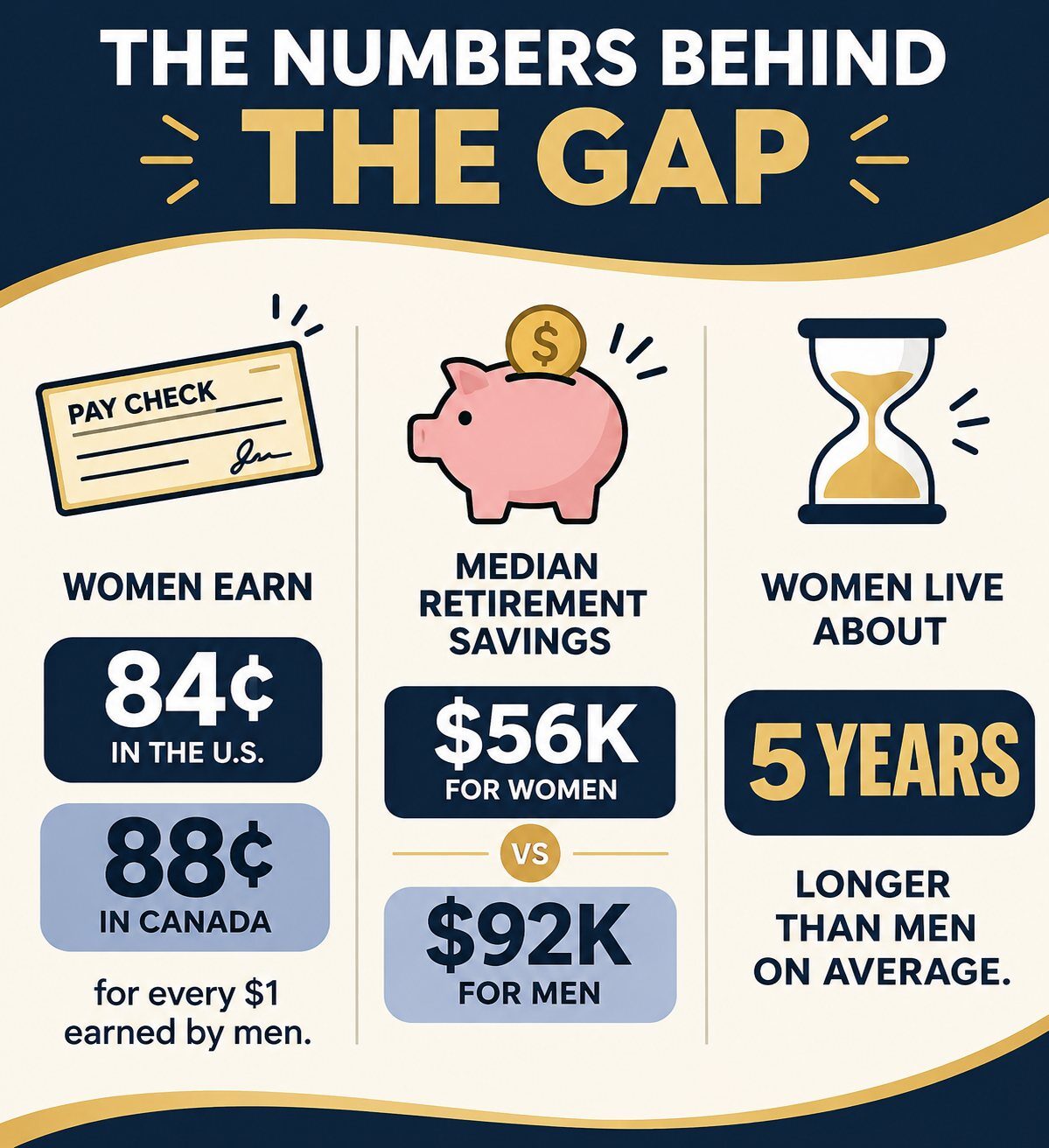
A few figures explain why planning matters so much.
- Pay. In the United States, women working full time, year-round earned 84 cents for every dollar earned by men in 2025, according to a Center for American Progress analysis of Census Bureau data. In Canada, women earned an average of 88 cents per dollar of men’s hourly wages in 2025, according to Statistics Canada.
- Savings. Women workers surveyed by the Transamerica Center for Retirement Studies reported a median of $56,000 in household retirement accounts, compared with $92,000 for men.
- Longevity. U.S. life expectancy at birth in 2024 was 81.4 years for women and 76.5 years for men (CDC). In Canada, the 2023 figures reported from Statistics Canada data were 83.9 years for women and 79.5 for men.
- Worry. In the same Transamerica survey, 44% of women workers said they fear outliving their savings, compared with 37% of men.
Put those together and the picture is clear: on average, women may earn less, save less and need their money to last longer. The gap is not about ability. It is about time, circumstance and the compounding effect of small differences over decades.
The good news is that compounding works in both directions. Small, early, consistent decisions can close a surprising amount of that distance.
3. Know Your Own Numbers

Many women manage the household budget with great skill and still have only a partial view of the household’s wealth: the pensions, investment accounts, insurance policies, debts and property titles that determine long-term security.
Financial independence starts with visibility. Whether you are single, married, divorced or widowed, you should be able to answer these questions without asking anyone else:
- What is my net worth: everything owned minus everything owed?
- Which accounts are in my name, and which are joint?
- Do I have credit history in my own name?
- What pension or workplace retirement benefits do I (and my spouse) have?
- What life and disability insurance is in place, and who are the beneficiaries?
- Where are the important documents, wills and passwords kept?
None of these questions requires distrust. They are simply part of being prepared. Life changes, sometimes suddenly, and the person who already understands the finances is the one who can make calm decisions when it matters most.
Writing down your goals, numbers and progress makes them real. The Mindset Architect Journal was built for exactly this kind of reflection and planning.
Explore The Mindset Architect Journal →4. Career Decisions Are Wealth Decisions

Your earning power is likely your largest financial asset, larger than any house or investment account for most of your working life. Decisions about it deserve the same seriousness.
That includes asking for raises, researching what your role pays elsewhere, building skills that are in demand, and treating each job change as a chance to raise your base pay rather than simply move sideways.
It also includes income beyond the main job. Earlier issues of this magazine explored practical side income: local services, repair and resale, small home jobs and digital work. Even a modest second income stream, directed entirely to savings or debt, can change a financial trajectory within a few years.
Negotiate once, benefit for years.
A raise does not just increase this year’s pay. It becomes the starting point for every future raise, every percentage-based retirement contribution and every employer match tied to salary.
5. Plan for Caregiving Before It Arrives

Caring for children, a spouse or aging parents is some of the most important work anyone does. It is also, too often, unpaid work that quietly interrupts savings, pension contributions and career growth.
The answer is not to avoid caregiving. It is to plan for its financial impact as a family, before it happens:
- If one partner steps back from paid work, keep contributing to that partner’s retirement savings. Spousal options exist for this purpose, such as spousal RRSPs in Canada and spousal IRAs in the United States.
- Keep skills and professional connections current during time away, even in small ways, so returning to work is easier.
- Talk openly about how caregiving years affect each person’s long-term security, not just this month’s budget.
- Review life and disability insurance whenever family responsibilities change.
Rules and limits vary by country and change over time, so confirm the details with a qualified advisor or official government sources before acting.
6. Make Saving Automatic and Investing Ordinary

The most reliable savers are rarely the most disciplined people. They are the people who removed the decision.
Automatic transfers on payday, workplace contributions taken before the money reaches your account, and a set percentage that rises with every raise all do the work quietly in the background.
Investing does not need to be exotic either. For most long-term savers, the essentials are time in the market, broad diversification, low fees and the patience to leave things alone through ups and downs. Starting with a small amount is far better than waiting for the perfect moment.
She considers a field, and buys it. With the fruit of her hands,
she plants a vineyard.
Proverbs 31:16 (WEB)
The woman described in Proverbs 31 evaluates, invests and plants for a future harvest. Long before modern finance, wisdom literature pictured wealth as something built patiently and stewarded with care.
7. Financial Freedom Is More Than a Paycheck

Wealth, in the end, is not a number on a statement. It is what that number makes possible.
It is the ability to leave an unhealthy job or relationship. To care for a parent without panic. To help a grown child without endangering your own future. To be generous. To retire on your own timeline. To say no.
That kind of freedom is built in ordinary ways: a clear view of your numbers, a growing gap between what you earn and what you spend, savings that run automatically, and decisions made with the long road in mind.
Five moves to make this month
- Calculate your net worth and write it down.
- Confirm which accounts and debts are in your name.
- Set up one automatic transfer to savings on payday, however small.
- Find out what your role pays elsewhere before your next review.
- Have one honest conversation about caregiving and long-term security.
Continue Your Wealth Journey
Explore More from Rich Abbott
Take the Wealth Mindset Assessment
Explore how your beliefs about money, capability and action may be shaping the financial decisions you make.
Take the Free Wealth Mindset Assessment →
Your Million-Dollar Why
Saving is easier when you know what you are building toward. Discover the purpose behind your financial goals.
Explore Your Million-Dollar Why →
The Wealthy Janitor
Proof that ordinary income, handled with patience and discipline, can build extraordinary security.
Keep Reading Wealth Code Magazine
Explore earlier feature issues on side hustles, small-town opportunities, resale and weekend handyman work.
Sources
Center for American Progress: gender wage gap, 2025 (Census Bureau data)
Statistics Canada: The gender wage gap persists
Transamerica Institute: 25 Facts About Women’s Retirement Outlook
CDC / NCHS: Life expectancy, 2024
Advisor.ca: Life expectancies rise (Statistics Canada data, 2023)
Editorial and Affiliate Disclosure
This feature is provided for general educational and informational purposes. It does not provide legal, tax, investment, financial-planning or other professional advice. Account types, contribution limits, tax rules and government benefits vary by country and change over time. Consult a qualified professional and official sources before making financial decisions.
Statistics cited are averages or medians from the sources listed and may not reflect any individual’s situation.
Some links in this issue may be affiliate links. RichAbbott.com may earn a commission from qualifying purchases at no additional cost to the buyer. As an Amazon Associate I earn from qualifying purchases. Some books and resources featured by Wealth Code Magazine are written or published by Rich Abbott.